
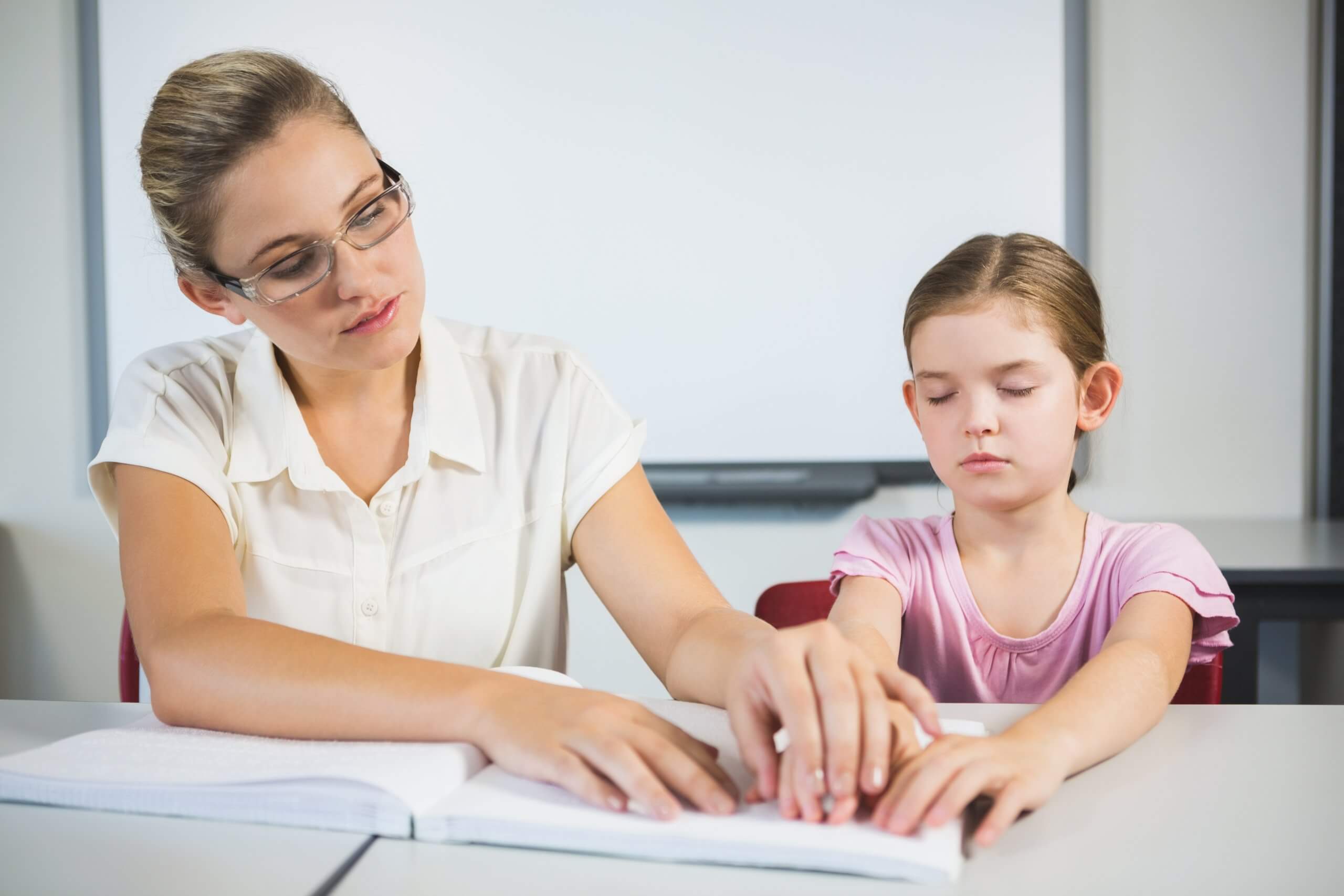
In this episode, Adrienne Shoemaker and Lauren Martone discuss the supports and components of an IEP for students who are blind or visually impaired, emphasizing the importance of collaboration, specialized instruction, and family involvement.
Key Topics
- The importance of the IEP team and its members
- Role of the teacher of the visually impaired (TVI)
- Functional vision assessment and learning media assessment
- The expanded core curriculum for visually impaired students
- Role of family in the IEP process
- Support strategies for access to academics and classroom materials
- Significance of orientation and mobility skills
- Advocacy tips for parents new to special education
- High expectations and access for students with visual impairments
Emily Woodward (00:03.352)
Today our guests are Adrienne Shoemaker, teacher of the visually impaired, and orientation and mobility specialist, and Lauren Martone, Family School Partnership Facilitator here at the Parent Information Center and Mom of 2, including one child with disabilities. Adrienne returns after her appearance on episode seven, where she shared valuable information about the American Printing House for the Blind, federal quota program, and why it matters to both schools and students.
Lauren is also back following her appearances on episodes 20, 22, and 23, where she discussed supporting deaf and hard-of-hearing students and the role of assistive technology. Today we will explore the supports and components of an IEP for a student who is blind and visually impaired, as well as identify key members of the team and common acronyms we may hear. Welcome back, Adrienne and Lauren. Thank you so much for joining us again.
Adrienne Shoemaker (01:02.596)
Thank you for having me.
Lauren Martone (01:04.128)
Yes, thank you for having us.
Emily Woodward (01:07.466)
Adrienne, to start, can you tell listeners about yourself, your background, and your career journey?
Adrienne Shoemaker (01:14.138)
Absolutely. I’m just about to start my 19th school year. I started my journey in education with an undergraduate degree in elementary and special education from Providence College. My first job was a classroom teaching position at the elementary level, and I worked for a few years before staying at home with my three children. During my time at home, I enrolled in the UMass Vision Studies program to obtain my master’s degree and become a teacher of students with visual impairments.
I was hired by Concord School District and over the years continued my education to add certification as an orientation and mobility specialist. And most recently I obtained my graduate certificate in cortical cerebral visual impairment. In addition to my work in school, I also serve as the lead point of contact between the field and the New Hampshire Department of Education in the role of Teacher of the Blind, Visually Impaired, APH scholar. In this role, I work on the American Printing House for the Blind federal quota New Hampshire APH Accessible Educational Materials and Assessment.
Emily Woodward (02:15.308)
What inspired you to work in the field of blindness and visual impairment?
Adrienne Shoemaker (02:19.778)
All right. During my time at home when my own three children were little, I knew that I’d be returning to work and wanted to obtain my master’s degree in what at the time I called an area of specialty. At the time I didn’t exactly know what that area would be. I had a small in-home daycare and was approached by a parent looking for some part-time childcare for her children. We got to talking and I learned that she worked with young children as a teacher of students with visual impairments and orientation and mobility specialist. What she did for work sounded fascinating. She told me about the degree program through the University of Massachusetts, Boston, and also that there was grant funding available. As soon as we got off the phone, I jumped on the website and started looking through the coursework. All the classes sounded so interesting and I knew at that moment that I wanted to apply and pursue becoming a teacher of the blind and visually impaired. It’s been an incredibly rewarding career, and I’m so thankful that I have pursued this path.
Emily Woodward (03:16.974)
For families that are new to special education, can you tell us what is an IEP team and why is it so important? And who should we consider including as part of the IEP team?
Adrienne Shoemaker (03:27.948)
All right. The IEP team is important because together they ensure the student’s needs are understood. The IEP team looks at the whole student, their strengths, learning style, interests, challenges, and goals. And every student with a disability is different. The IEP identifies the specific instruction, accommodations, services, and supports that the student will need to be successful. No single person has all the answers, and the best outcomes happen with families, educators, and specialists share information and work towards common goals. For students who are blind or visually impaired, the IEP team plays a vital role in making sure the student not only has access to academics, but also to specialized instruction needed to fully participate and thrive. One of the components of an IEP team for a student who is blind or visually impaired would be the teacher of the visually impaired, or also known as TVI, who’s a specially trained educator who conducts the assessments and provides instruction and supports to students who are blind or visually impaired. The role of the TVI is to ensure that students with ocular visual impairments and/or cortical cerebral visual impairment have meaningful access to learning materials and environments and develop independence and self-advocacy skills to fully participate in school and life. The student with ocular visual impairments may have challenges related to the eyes or visual system. While a student with CVI may have challenges related to the brain’s ability to process and interpret visual information, some students may have both ocular and CVI related needs. The TVI is also important to have on the team because they’re the ones who conduct the assessment of functional vision. This assessment looks at how a student uses vision in everyday situations, not just the medical diagnosis or visual acuity. The key question the functional vision evaluation answers is: how does this student use vision to access learning and participate in daily activities? Areas of the FVA or functional vision assessment include visual acuity and its impact on school tasks, reading efficiency, preferred print size, contrast needs, lighting preferences, glare sensitivity, visual field considerations, tracking and scanning skills, and use of magnification or assistive technology. For our students who have cortical or cerebral visual impairment, the TVI will also assess visual attention and engagement, ability to locate and recognize objects, response to color, movement and contrast, visual complexity tolerance, distance viewing, visual fatigue, impact of positioning, lighting, and environment, and the ability to interpret visual information. As a TVI, we also assess and provide instructions in the areas of the expanded core curriculum. So, the expanded core curriculum, also called the ECC is a specialized curriculum designed for students who are blind or visually impaired. While students with visual impairments participate in the general education curriculum, they may need additional instruction in specific areas because many skills that cited students learn incidentally through observation must be intentionally taught. So, the ECC includes nine areas of instruction that support students in becoming independent, successful, and active participants in school, community, and adult life. So, some of those areas include compensatory and access skills, assistive technology, orientation and mobility, independent living skills, career education, self-determination and self-advocacy, recreation and leisure skills, social interaction skills, and sensory efficiency skills. So the TVI should be an integral member of the IEP team because visual impairment affects how a student accesses instruction, not simply how well they see.
One of the important, a really important part of the IEP team is also the family’s role. They are especially important. They’re equal members of the team. The parents know their child in a way that no one else does, and their input helps ensure that the plan reflects the child’s needs, strengths, and future goals. For students who are blind and visually impaired, the IEP team plays a vital role in making sure the student not only has access to academics, but also the specialized instruction needed to fully participate and thrive.
Lauren Martone (07:48.414)
Adrienne, I really love how you mentioned the importance of the family being a part of the team. I think oftentimes these meetings feel so overwhelming, and the educational team almost feels intimidating to the family members. So I love that professionals can emphasize that importance of the role of the family on the team and that we can appreciate how the family really is the expert on the child. I know when my son was diagnosed with cortical visual impairment, I definitely did not feel like an expert, but it was so important for me to bring the experiences that I know he had to that table. So thank you for emphasizing that.
Adrienne Shoemaker (08:28.684)
Absolutely. And it’s great that you were able to share that.
Emily Woodward (08:42.378)
Adrienne, how does a TVI support access to academics and classroom materials?
Adrienne Shoemaker (08:47.706)
All right, so a TVI supports access to academics by looking beyond whether a student can technically see something and determine whether the student can access, understand, and use the information efficiently and independently. A TVI supports access to specialized content. So the academic subjects can create unique accessibility challenges. So as a TVI, we’re going to work with teachers to determine how a student can access things like a geometry diagram, a science lab, a map, a graph, a musical notation, computer-based simulations, chemistry models, or visual demonstrations. So, this often requires a lot of pre-planning and also creative problem solving and collaboration. So, the TVI’s role is to prepare for access and not just react to the barriers. So, an important part of the role is anticipating what is coming. So, if the science teacher is beginning a unit containing complex diagrams and the student needs tactile graphics, the TVI needs to know before the lesson, not after the student has already missed the instruction. So, one of the important roles of a TVI is to collaborate with educators and families as a bridge between the student’s visual needs and the educational environment. So, the collaboration is ongoing and can look different depending on the student’s age, needs, and level of independence. So, as a TVI, when we collaborate with educators, we may be explaining how a visual impairment affects access to instruction in classroom routines. We could be recommending appropriate accommodations and modifications, helping the teacher to understand the student’s preferred learning media, be it print, large print, braille, auditory, tactile, or a combination. We’re going to want to review upcoming lessons and identify materials that may need to be adapted. We can help make worksheets, presentations, digital documents, graphs, maps, and other visual materials accessible. We collaborate on accessible technology and digital platforms. We can model strategies for presenting visual information verbally or textually. We provide information about the student strengths, needs, and effective strategies, and then monitor whether accommodations are actually working and make adjustments when needed.
Adrienne Shoemaker (10:57.924)
The TVI also provides direct instruction and supports accessible technology. So as a TVI, we help students to learn independently, how to independently access the technology used by their school, and how to use additional technology that is personalized to the student. So this could include screen readers, magnification tools, specialized software, braille displays, Chromebooks, computers, tablets, smartphones, built-in accessibility features, digital textbooks, and accessible PDFs. We also look at the learning management systems that are being used by the schools, such as Google Classroom, Canvas, or Schoology. The TVI works with teachers to ensure that digital materials themselves are accessible, rather than simply expecting the student to figure out how to access in an accessible document. The TVI teaches strategies for using vision efficiently. So for students with some usable vision, the TVI may teach strategies such as appropriate viewing distance, positioning materials, using magnification, tracking and scanning, reducing visual clutter, using line guides, adjusting font sizes, spacing and contrast, managing visual fatigue, and selecting appropriate lighting. So for our students who are braille readers or developing Braille skills, the TVI may teach unified English Braille. Produce or coordinate Braille materials, provide tactile graphics, and teach students how to access tactile interpretation, support Braille technology, and help ensure that Braille materials are available at the same time as their peers’ materials. For students with CVI, our support might include large print or braille materials, simplified visual displays, reduced background clutter, presenting one item at a time, use of preferred colors. Increased processing time, familiar objects and routines, pairing visual information with verbal descriptions and experiences. Another important piece of the role is the collaboration that we have with families. So, as we discussed above, families provide information that educators cannot always see in the school setting. So TVIs may collaborate with families to understand how the student functions at home and in the community, what visual strategies the student uses naturally.
Adrienne Shoemaker (13:14.094)
Technology and accessibility tools used outside of school, areas where the student is demonstrating increasing independence or dependence, concerns or changes noticed by the family, and the long-term goals and priorities for the student. In addition to the classroom teacher and the families, the TVI was also going to collaborate with the entire team. So they were going to be working with special educators. Occupational therapist, speech and language pathologist, orientation mobility specialist, assistive technology specialists, school administrators, school nurses, related service providers, and outside vision professionals when appropriate. So each person on the team is going to bring a different level of expertise, and the TVI helps ensure that visual access is considered across all areas of the student’s educational program. Most importantly, collaboration should center on the student. So that effective collaboration involves listening, problem solving, sharing expertise, and building consistency across environments. The ultimate goal is for everyone supporting the student to have a shared understanding of what does this student need to access learning and how can we help them become increasingly independent in accessing it.
Emily Woodward (14:32.258)
Thank you so much for all of that great information. Could you tell us what an O and M and a C O S what those acronyms stand for? Many people have never heard of these terms before.
Adrienne Shoemaker (14:45.402)
Absolutely. So O and M and a COMS. So O and M stands for Orientation and Mobility. So that’s a specialized service that helps ensure students who are blind or visually impaired move safely, efficiently, confidently, and as independently as possible through their environments. So the orientation piece of it is knowing where you are, where you want to go, how to get there, what landmarks, sounds, textures, or other environmental information can help you navigate.
And the mobility piece of that is the ability to move safely and efficiently through that environment. So an O and M specialist is often called a COMS, which stands for a certified orientation and mobility specialist. And that is the professional who teaches these skills.
Emily Woodward (15:36.504)
Thank you. What skills do students gain through orientation and mobility instruction? And why are these skills important?
Adrienne Shoemaker (15:44.61)
Okay. So O and M instruction can begin at a very young age and continue through adulthood. And depending on the students’ needs, instruction might include body awareness and spatial concepts, understanding directions such as left, right, above, below, and near far. It could be learning routes within the school, navigating hallways, stairways, and doorways, identifying landmarks and environmental cues, using auditory and tactile information to navigate. Safe street crossings, understanding intersections and traffic patterns, how to use a white cane. Orientation mobility instruction could center around productive techniques for avoiding obstacles, traveling independently in unfamiliar environments, using public transportation, using GPS and accessible navigation technology, and developing those problem-solving and self-advocacy skills. So O and M isn’t just about using a cane, which could be one of the biggest misconceptions. That it’s synonymous with cane travel. A cane is an important tool, but O and M is really about independent travel and navigation. So a student with usable vision may receive O and M instruction even if they do not use a cane. So for example, an O and M specialist might teach a student how to determine when it’s safe to cross the street, use environmental sounds to gather information, identify the shape and characteristics of an intersection, navigate a busy school environment, find a specific classroom independently. And again, use that GPS app to travel to a new location. So it’s really important because academic access and physical independence go hand in hand. So a student may have the skills to read, write, use technology, and participate academically, but without the ability to navigate their environment safely and independently, these opportunities can be significantly limited. So orientation and mobility develops independence. It teaches students how to move from one place to another, without relying on a parent, teacher, professional, or peer to guide them. Orientation mobility provides safe travel, so students learn strategies for navigating obstacles, stairs, doorways, intersections, and environmental challenges, and they learn to gather information through auditory, tactile, visual, and environmental cues.
Adrienne Shoemaker (18:05.196)
O and M provides access to the world beyond the classroom. So it’s important because it allows students to move beyond familiar school environments and develop skills for navigating their homes, neighborhoods, communities, workplaces, college campuses, and public transportation.
Emily Woodward (18:25.812)
Why is blindness or visual impairment considered such a specialized area within education?
Adrienne Shoemaker (18:32.772)
So, blindness and visual impairments are considered a highly specialized area within education because vision is one of the primary ways people traditionally access information, learn about their environment, and develop independence. So, when a student has a visual impairment, they may need specialized instruction, materials, tools, and strategies to access the same learning opportunities as their peers. Their educational needs involve understanding how they learn, how they access information, and what skills they need to become independent. So we find is the diagnosis does not tell the whole story. Two students that have the same eye condition may have very different educational needs. So a TVI considers how the student uses vision functionally, visual fatigue, reading efficiency, environmental factors, learning style, technology skills, and future needs and goals. So vision affects access to learning. So most classroom instruction is designed around visual information. Which includes textbooks, worksheets, whiteboards, smartboards, demonstrations, pictures and illustrations, graphs, charts, maps, classroom organization, and visual schedules. There’s also digital content that’s presented in online platforms. So the student with a visual impairment may need specialized approaches to access this information. Many skills that cited students learn incidentally through observation must be intentionally taught to students who are blind or visually impaired. These skills are not automatically developed through the general education curriculum. An important question is: how does the student access information and what tools and skills will allow them to learn independently? Independence often requires specialized instruction. For many students, success is not just about completing assignments, it’s about developing the ability to access information independently, navigate environments safely, use technology effectively, advocate for their needs and participate fully in school and community life. Visual impairment is also a low incidence disability compared to other disabilities. So most educators do not receive extensive training in eye conditions and their functional impact, braille instruction, accessible instructional materials, vision-specific, blindness-specific technology, orientation mobility skills, and the impact of visual impairment on learning. This is why specialized personnel, such as teachers of students with visual impairments and certified orientation mobility as specialists are essential members of the educational team. Blindness and visual impairments are specialized areas because access doesn’t happen automatically. It requires intentional assessments, specialized instruction, appropriate tools, accessible materials, and a team that understands how to remove barriers while maintaining high expectations.
Lauren Martone (21:24.768)
I love that you mention how this is a low-incidence disability compared to other disabilities, and most educators don’t receive training for a lot of this and the accommodations that need to be in place. I know for my son, he presents himself as a perfectly sighted individual. His acuity is even better than mine. But he does need specialized instruction. He gets visual fatigue and he needs to be able to take breaks. He needs his material presented to him more closely or to be seated in a preferential seat. And I think that it’s just important for all members of the team to learn about these disabilities and what can be successful for these kids.
Adrienne Shoemaker (22:10.968)
Absolutely. Thank you for sharing.
Emily Woodward (22:16.046)
What are some common signs that families can look for that a student’s IEP team may be missing important supports related to their child’s vision?
Adrienne Shoemaker (22:26.49)
Right, so families play a really important role in noticing when a vision a student’s visual needs may not be fully addressed. So a student with a visual impairment may be capable of learning the same content as the peers, but if the appropriate supports are missing, the student may appear to struggle in ways that are actually related to access and not ability. So some signs that an IEP team may be missing important vision related supports include that the student may be working much harder than peers to complete the same task.
Families may notice that students are holding materials very close or leaning into view. Homework takes an unusually long time. The student becomes tired and frustrated after reading. The student avoids reading and writing activities altogether. The student needs frequent breaks. They appear to know the material but struggle to complete assignments. So these are examples of situations in which a student may spend so much effort accessing information that less energy is available for learning. So additional examples may include that the student understands a lesson when information is explained verbally but struggles with worksheets or textbooks, they have difficulty copying from a board or a screen, they miss details and charts, graphs, pictures, or diagrams. And as families, you can seek clarification to ensure that the students’ accommodations are specific. So for example, like Lauren mentioned, preferential seating. So that might be listed, but there may be no explanation of where or why. The same for large print is provided, but we don’t have details about the font size, spacing, contrast, or format. So we want to look for just more information about the accommodation that’s in place and to make sure that it’s specific enough. So technology is listed, but the student has not been taught how to use it effectively. So you’d be looking that there would be areas where the student would have opportunities to learn that how to use their technology. And also it’d be a flag if the materials are adapted after the lesson instead of being available when instruction occurs. So if the student doesn’t have a clear learning media plan, families might want to ask: Does the student learn best through print, large print, braille, auditory methods, tactile materials, or a combination? Has a learning media assessment been completed? Is the chosen learning media still appropriate as a student grows in academic needs and demands increase? So a student who can read print may not always be a student who can efficiently use that print. You want to look at if the students receiving instruction in those disability-specific skills of the expanded core curriculum. So for students with visual impairments, the IEP may need to address skills beyond academics, such as the compensatory access skills, assistive technology, orientation and mobility, independent living skills, career education, self-determination, and self-advocacy, also looking at recreation and leisure skills, social interaction skills, and sensory efficiency skills.
So back to the technology, again, it might be listed, but the student doesn’t have independence in using it. So the device alone does not equal access. Signs might include that the student is relying on others to operate their technology, the student avoids using their device, the student cannot access digital assignments independently. The technology is used inconsistently across classes. So our students need direct instruction to develop efficient technology skills. Another area would be if the student may be having difficulty navigating environments independently. So some possible signs that orientation and mobility may need to be considered is if the student relies on adults or peers to move around the school, the student avoids unfamiliar areas, the student has difficulty identifying landmarks or routes, the student has safety concerns when moving through environments, and the student lacks confidence in traveling independently. The student may also have difficulty explaining what they need. Students may need explicit instruction in self-advocacy, including asking for accessible materials, explaining how they learn best, requesting accommodations, and understanding their own vision needs. So, questions the families could consider asking the IEP team would be: How is my child accessing the same information as their peers? Has a TVI been involved in determining their access needs? Does my child need instruction in Braille, assistive technology, or other vision-related blindness skills? Are accommodations helping my child to become more independent or are they creating dependence on others? And is my child being taught the skills they need for future independence?
Emily Woodward (27:17.112)
Thank you. What advice would you give parents advocating for services for the first time?
Adrienne Shoemaker (27:24.378)
So advice I’d give for parents advocating for services for the first time, I think I’d be requesting evaluations that would look at how the child functions and not just a diagnosis. So the medical eye report provides important information, but it doesn’t tell the educational team how a student uses vision for learning or for accessing their environment. So a student with a visual impairment should be evaluated based on their functional needs in educational settings. So, one of the roles we’ve already mentioned about a TVI does is to conduct that functional vision evaluation to assess how a student uses vision to access information and perform everyday tasks across educational, home, community, and other functional environments. So the functional vision exam examines how the student uses vision during activities such as reading and writing, viewing classroom materials, information at near and distance, using technology. Locating and identifying objects, recognizing people and facial expressions, navigating visual environments, and completing tasks that require visual attention and discrimination. So this evaluation also considers the ability to detect, identify, and interpret visual information, visual acuity, and the impact of the student’s diagnosed, visual condition on functional performance, visual fields, eye-hand coordination, visual tracking and scanning, fixation. Visual tension and efficiency and effects of fatigue, visual demands, and task complexity. So environmental factors such as lighting, glare, color, contrast, background clutter, distance, positioning, and movement are also considered, as well as the student’s use of visual information in different settings and under varying conditions. So the FEE may gather information about the student’s preferred materials across the environments, visual access strategies, compensatory strategies, and the use of optical and electronic devices or other assistive technology. It considers how visual functioning affects participation, independence, safety, communication, academic performance, and access to the general curriculum. Information gained from the FEE helps determine appropriate print size, font characteristics, spacing, contrast, lighting, seating, and positioning.
Adrienne Shoemaker (29:38.478)
Visual presentation of materials, environmental modifications, visual strategies, assistive technology, and accommodations, as well as whether the student requires direct instruction and specific skills related to their visual impairment. The results provide the educational team with a clear understanding of the student’s functional use of vision and supports needed to maximize access, independence, participation, and success across settings. Another assessment to request, and is usually part of the functional vision assessment, is the learning media assessment. So that’s the educational evaluation designed to determine the most effective ways a student with a visual impairment accesses, processes, and learns information. So rather than focusing solely on a student’s visual diagnosis, the LMA examines how the student learns and identifies the most effective use of visual, textual, and auditory information. This may include determining whether a student learns most efficiently through print, large print, braille, auditory methods, tactile materials, digital materials, or a combination of learning media. The LMA helps the educational team identify the students’ preferred sensory channels, determines the most efficient literacy and functional learning media for current and future needs, and makes informed decisions regarding print size, braille instruction, audio supports, assistive technology and dual media approaches. So we want to look at the LMA. It’s going to look at that sensory use, literacy skills and development, functional use of vision and other senses, and learning preferences across academic, functional, leisure, and environmental settings. The assessment is important because it bases educational decisions on observed performance rather than assumptions and provides information that can help guide the IEP development, accommodations, curriculum adaptations and technology recommendations.
Adrienne Shoemaker (31:37.87)
We mentioned before about the expanded core curriculum. So those assessment areas should be covered as well. So in that, you want to remember so you could request the ECC eval if it’s not already included in that, where we looked at those nine areas that we mentioned previously in the podcast. So I feel like the biggest thing is to remember that you’re an important member of your child’s educational team. So you know your child the best, your observations, questions, and concerns. Provide essential information. As parents, you’re often the first to notice that something is different or that your child’s working harder than expected. So you want to pay attention to what tasks are easy or difficult at home. When does your child become tired, frustrated, or avoid certain activities? How do they navigate familiar and unfamiliar environments? How do they access toys, books, screens, and everyday activities? What are their strengths, interests, and abilities? And what strategies help them to succeed? So be sure to share these observations with the school team. And again, your perspective is valuable and helps the school team understand how your child functions across settings.
Lauren Martone (32:51.736)
Adrienne, this is such valuable and excellent advice. I just want to remind our listeners that there are supports and agencies out there, like the Parent Information Center. We have an incredible intake team that can help answer questions and a great website full of resources. And parents, don’t be afraid to ask those questions and be the squeaky wheel. You really do know your child best.
Emily Woodward (33:18.774)
What advice would you give now to educators who may be working with a blind or visually impaired student for the first time?
Adrienne Shoemaker (33:26.906)
So I’d say the most important thing is to focus on to focus on is that the student is a learner first. So their visual impairment does not define their abilities, potential, or expectations for success. You want to get to know the student’s strengths, interests, situations that are challenging for them, how they prefer to access information, the tools and strategies that they use, and what helps them feel confident and independent. So again, we want to focus on access and encourage independence. How can the student access the same learning objectives? The student may need different materials, additional time, technology, verbal descriptions, adapted visual or tactile materials, and alternative ways to demonstrate learnings. So we need to make these sure that these materials are accessible from the beginning. It’s important to understand the role of the TVI and COMS, so the teacher of the visually impaired and the certified orientation and mobility specialist, and utilize their expertise, support, and collaborate with them to remove barriers.
Lauren Martone (34:28.01)
Again, I think this is such great advice and I really agree with everything Adrienne’s saying here. These teams really can lean on each other and the parents, not don’t be afraid to ask questions and help clarify things. And remember that our students are often the best teachers when it comes to what works best for them.
Adrienne Shoemaker (34:48.474)
Absolutely. I recently heard a quote that said “it’s important to become a student of your student.” So like you said, to really learn from what our kiddos are telling us. Yeah.
Lauren Martone (34:57.44)
I love that.
Emily Woodward (35:01.858)
What is one final message that you would like to share to help others better understand and support students who are blind or visually impaired?
Adrienne Shoemaker (35:11.074)
Yes, to sum it up in one message would be to presume competence, to have high expectations, and provide access. So we need to understand how our students learn best, collaborate with TVI and COMS, and make sure that the student has accessible materials, specialized instruction, technology, and those opportunities to develop independence and self-advocacy skills.
Lauren Martone (35:34.315)
And I would just add that all of these students are different and visual impairments really are a spectrum. So it’s important to really lean into each other and the child.
Adrienne Shoemaker (35:47.322)
Absolutely.
Emily Woodward (35:51.064)
Thank you both. That’s excellent advice. What gives you hope when you look at the next generation of students?
Adrienne Shoemaker (35:58.874)
So, individuals who are blind or visually impaired continue to show us that vision does not define their potential. So, when those barriers are removed and students have access to appropriate instruction, technology, and opportunities, they’re able to pursue their goals, advocate for themselves, and develop that independence. So the next generation, they’re growing up with expanding access to technology, increased awareness of accessibility, and a greater understanding that inclusion means meaningful participation and not simply being present.
Lauren Martone (36:30.466)
There’s a lot of hope to be had, that is for sure.
Adrienne Shoemaker (36:33.183)
Hmm.
Emily Woodward (36:37.026)
Thank you both so much for joining the podcast today, Adrienne and Lauren. This information is so valuable to families of students with visual impairments.
Adrienne Shoemaker (36:48.199)
Thank you for having me. This has been great.
Lauren Martone (36:50.956)
Thank you so much, Adrienne. We truly appreciate your expertise and information that you share with us.